Home blood collection, step by step
Home blood collection is coming soon at Santé Labs. In a home draw, a trained professional comes to your address, draws your blood and takes the samples to the laboratory. The preparation is the same as for a lab visit. What changes is where the blood…
En este artículo
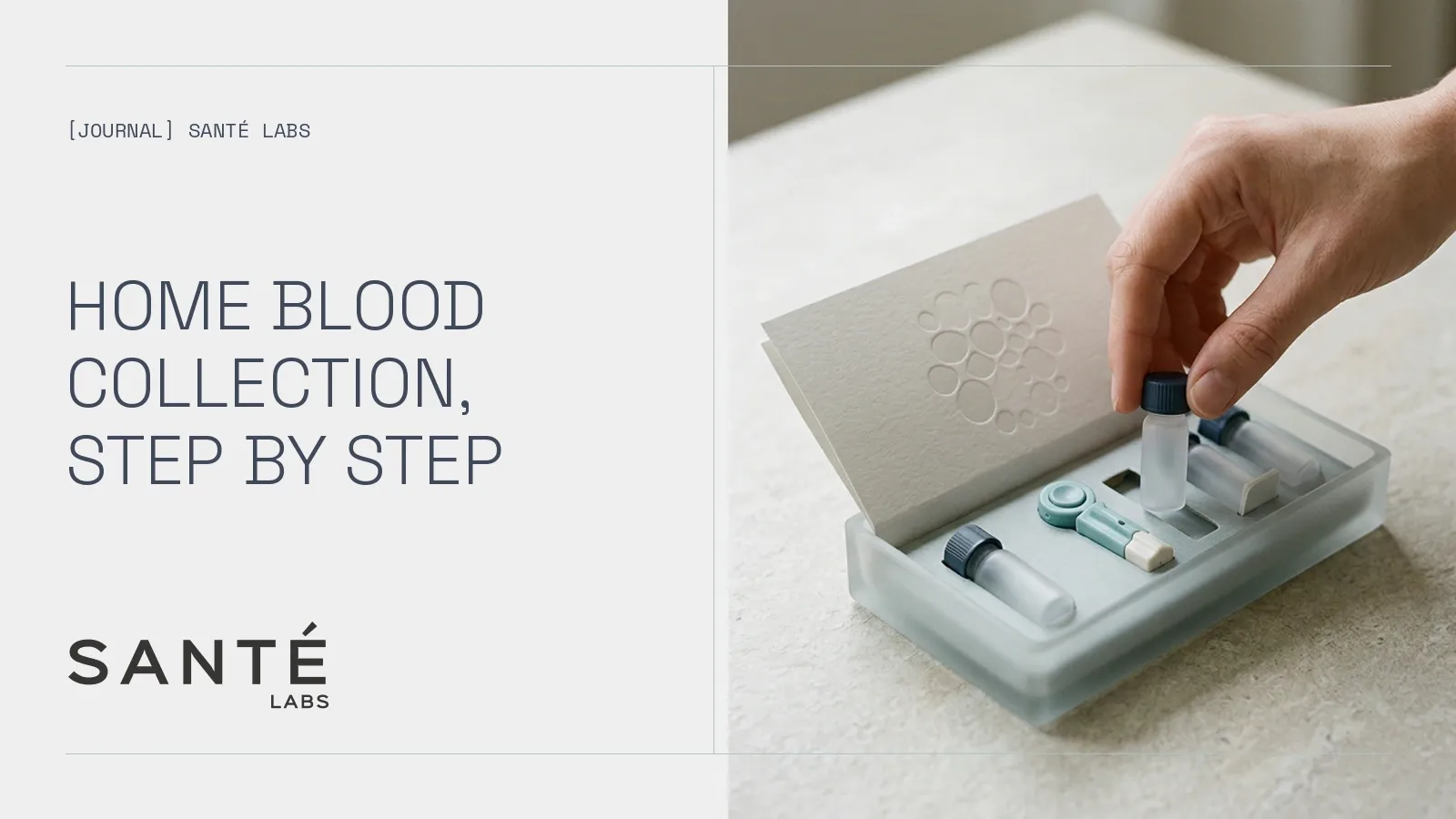
Home blood collection is coming soon at Santé Labs. In a home draw, a trained professional comes to your address, draws your blood and takes the samples to the laboratory. The preparation is the same as for a lab visit. What changes is where the blood is drawn and how the samples travel.
Key takeaways
- Home visits are not bookable yet. Today you can book a set of profiles in Barcelona, listed below.
- Preparation follows European guidance: an early morning draw, fasting when your tests need it, water allowed, no intense exercise the day before [1][2].
- At home you are already rested and seated, which the guidance recommends for 15 minutes before a draw [2].
- The main difference is transport. Time and temperature between the draw and the lab affect some results, especially clotting tests [5][8].
- Reference ranges vary by lab, sex and age. Discuss your results with your doctor.
Why home collection
Some people find it hard to reach a lab before work. Others prefer not to sit in a waiting room. A home draw takes the same blood, in the same tubes, with the same technique. The World Health Organization guidance on phlebotomy applies wherever the draw happens: a trained person, clean equipment, correct identification and safe handling of needles [3].
There is no shortcut in the science. A home draw is a lab draw that happens somewhere else.
How it will work at Santé, step by step
Home visits are still being prepared and the details are not confirmed yet. The outline below follows European and WHO guidance on blood sampling. We will confirm how each step works when booking opens.
1. You choose your profile and a time
You pick a profile, for example the Complete Thyroid Profile or the Glycaemic Control Profile. Morning times tend to matter most, because many tests are best drawn early and fasting [1][2].
2. You receive preparation instructions
Each profile has its own needs. The Glycaemic Control Profile includes glucose and triglycerides, so fasting matters. The Complete Thyroid Profile does not depend on a meal in the same way. Your instructions should say which applies to you.
3. The professional arrives and confirms who you are
The guidance asks for at least two identifiers, such as your full name and date of birth, checked against the request and the tube labels [2]. Expect to be asked these questions even if it feels obvious.
4. The draw
You sit or lie down. European guidance recommends that a tourniquet, if used, stays on for no more than one minute [2]. The tubes are filled in a fixed order and inverted gently to mix [2]. If you tend to feel faint, say so. Lying down is the recommended position in that case [2].
5. Aftercare
Press on the site until the bleeding stops. The guidance gives about 2 minutes for routine draws and up to 10 minutes if you take anticoagulants [2]. Keep your arm straight. Rest for about 5 minutes before you get up and carry on [2].
6. Transport and analysis
The samples travel to the laboratory for analysis. How long they spend on the way, and at what temperature, matters for some tests, as explained below.
What to prepare
These rules come from the joint European (EFLM) and Latin American (COLABIOCLI) recommendation for venous blood sampling, also published in Spanish [1][2]. Your instructions for a specific profile take priority.
| What | What the guidance says | Source | Caveats |
|---|---|---|---|
| Time of day | Ideally between 7 and 9 a.m. | [2] | Some tests have daily cycles. Follow the timing your doctor asks for. |
| Fasting | 12 hours after the last meal. Water is allowed. | [2] | Not every test needs it. A lipid profile does not routinely require fasting [4]. |
| Alcohol | None in the 24 hours before | [2] | |
| Coffee, tea, energy drinks, smoking, gum | Avoid on the morning of the draw | [2] | |
| Exercise | No intense activity, beyond your usual level, in the 24 hours before | [2] | |
| Rest | Sit for 15 minutes before the draw | [2] | Easy at home. Avoid rushing around just before the visit. |
| Medicines | Avoid non-essential medicines before the draw | [2] | Never skip or move a prescribed dose without asking your doctor. |
| Supplements | Tell us about them, especially high-dose biotin | [2][7] | Biotin can distort some hormone and thyroid immunoassays [7]. Ask your doctor before pausing any supplement. |
Drink water. Well-filled veins make the draw easier, and water is allowed during the fast [2].
What is different from a lab visit
Rest and posture
Changing from lying to standing, or the reverse, can change many lab values [2]. At home you are usually rested already. That is one point in favour of a home draw.
Transport time and temperature
This is the real difference. In the lab, a sample can be processed within minutes. From home, it has to travel. A review in the clinical lab literature names temperature during transport and the time to centrifugation as some of the biggest hurdles for remotely collected blood [2][5].
Not every test is equally sensitive:
- Potassium. In one small study of 20 donors, serum potassium was mostly stable at room temperature for 4 hours before centrifugation. Some samples still changed significantly [6].
- Clotting tests (PT, APTT). A 2025 consensus from the Spanish Society of Laboratory Medicine pooled 43 studies. It estimated that APTT lengthens by about 6.1% at 6 hours and 10% at 24 hours. PT changes by about 2.9% per day, although that model was weaker. Tube handling mattered more than storage temperature [5].
So some profiles suit a home visit better than others. When home visits open, we will say which profiles are offered at home and which are best drawn at the lab. If you need clotting tests, ask your doctor which option fits your situation.
Reading results
A result is compared with a reference range. That range depends on the lab, the method, your sex and your age. A value from another lab may not match ours exactly. Discuss any result with your doctor, not just the flag next to it.
What you can book today
Home visits are coming soon. In the meantime you can book these profiles in Barcelona: Bone Health, Coagulation and Thrombosis, Complete Liver Profile, Basic Kidney Profile, Glycaemic Control Profile, Complete Thyroid Profile, Basic Female Hormone Profile and Basic Male Hormone Profile. The Standard Lipid Profile is coming soon.
FAQ
Is a home draw as accurate as a lab draw?
The technique is the same [2][3]. The difference is the time and temperature on the way to the lab. These affect some tests more than others [5][6][8].
Do I always need to fast?
No. Fasting depends on the tests. Glucose and triglycerides are usually drawn fasting. A lipid profile does not routinely require it [4]. Your instructions will tell you.
Can I take my usual medicines?
The guidance suggests avoiding non-essential medicines before the draw [2]. Do not skip or delay a prescribed dose without speaking to your doctor first.
I take biotin. Does it matter?
It can. High-dose biotin can interfere with some hormone and thyroid tests [7]. Tell us before the draw and ask your doctor whether to pause it.
When can I book a home visit?
Not yet. Home visits are coming soon. In the meantime you can book the profiles listed above in Barcelona.
How long until I get results?
We will confirm the timing when you book. When your results arrive, review them with your doctor.
References
- Simundic AM et al. Joint EFLM-COLABIOCLI Recommendation for venous blood sampling. Clin Chem Lab Med. 2018;56(12):2015-2038 – https://pubmed.ncbi.nlm.nih.gov/30004902/
- Recomendaciones conjuntas EFLM-COLABIOCLI para la extracción de muestras de sangre venosa (Spanish translation) – https://www.eflm.eu/upload/docs/Spanish-translation-Venous_blood_collectionV1.pdf
- World Health Organization. WHO guidelines on drawing blood: best practices in phlebotomy. 2010 – https://www.who.int/publications/i/item/9789241599221
- Nordestgaard BG et al. Fasting is not routinely required for determination of a lipid profile. EAS/EFLM joint consensus. Eur Heart J. 2016 – https://pubmed.ncbi.nlm.nih.gov/27122601/
- Gómez Rioja R et al. (SEQCML Extra-analytical Quality Committee). Consensus instability equations for routine coagulation tests. Clin Chem Lab Med. 2025 – https://pubmed.ncbi.nlm.nih.gov/40156303/
- Harper A et al. Reproducibility of serum potassium values in serum from blood samples stored for increasing times prior to centrifugation and analysis. J Clin Lab Anal. 2016 – https://pubmed.ncbi.nlm.nih.gov/25867784/
- Li D et al. AACC Guidance Document on Biotin Interference in Laboratory Tests. J Appl Lab Med. 2020 – https://pubmed.ncbi.nlm.nih.gov/32445355/
- (removed – unsupported future-dated source)